
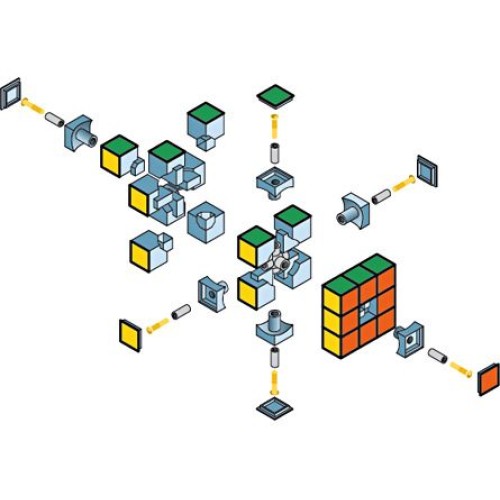
Speedcube Anatomy: Spring, MagLev, Dual Adjustment, and Ball Core — explained simply
“The Feel Builder: how the core and settings change your cube”
A short guide to the “insides” of cubes and how they affect speed, control, and stability.
Why this guide exists
When a product description includes terms like Spring, MagLev, Dual adjustment, or Ball Core, buyers often don’t understand what they’re actually getting — and why some cubes feel “soft,” others feel “fast,” and others feel “super stable.”
This material explains four key concepts and helps you quickly choose a construction that matches your style.
Core and tension: four terms that matter most
1) Spring — the classic setup
What it is: a standard core where each center cap hides a screw + spring.
What you adjust: by turning the screw you change the tension (how tight/loose it feels).
How it feels
- an elastic, “springy” rebound;
- sometimes a light noise/squeak if the springs are dry.
Pros
- reliable and easy to understand;
- easier to maintain;
- usually cheaper.
Cons
- a bit more mechanical friction than MagLev;
- budget models may have less “fine” tuning.
Who it’s for
- beginners and most hobbyists;
- schools/clubs;
- a universal, straightforward option.
2) MagLev — “springs replaced with magnets”
What it is: instead of a spring, a pair of magnets is used. They repel each other and create a spring-like force (Magnetic Levitation).
What it does: less mechanical friction → the cube often becomes faster.
How it feels
- faster and “cleaner” turning;
- usually quieter (no spring squeak), but it can have a “magnetic” response character.
Pros
- higher speed;
- fewer issues with spring noise.
Cons
- can become too fast without tuning;
- can feel “sharper” to some people.
Who it’s for
- people who like fast cubes;
- those willing to do a bit of tuning.
3) Dual adjustment — separate control of “tightness” and “stability”
What it is: a system where two things are adjusted independently:
- Tension — how “tight” the centers are (play, layer freedom).
- Compression — how “compressed” the cube is overall (affects stability, lockups/catching, and control).
How it’s implemented
- in addition to the screw, there’s a ring/click system/washer with positions (e.g., 1–5, 1–8);
- you set compression separately and tension separately.
Why it matters
You can achieve a combination like:
- fast but stable, or
- controlled but not “sluggish”.
Pros
- a wide tuning range;
- easier to find the “ideal” feel for your hands.
Cons
- at first, beginners may not know what to adjust;
- slightly harder to explain/choose without experience.
Who it’s for
- anyone who wants tuning “to their taste”;
- especially those who turn fast and feel the differences.
4) Ball Core — a “premium” magnetic core for stability
What it is: a special core construction (often ball-shaped) + magnets between the core and corners (corner↔core).
Important: Ball Core is an add-on. It can be combined with Spring, MagLev, and Dual adjustment.
How it feels
- noticeably higher stability;
- stronger auto-centering;
- less “floating” at high speed.
Pros
- better control at speed;
- fewer twists/lockups during aggressive turning;
- a “premium” solid, monolithic feel.
Cons
- usually more expensive;
- can feel “too magnetic/too stiff” for some.
Who it’s for
- those who want maximum stability;
- those who already turn fast and value control.
Quick choice (10 seconds)
- I want a reliable cube with no fuss → Spring: a classic spring core — reliable and predictable.
- I want faster and lighter → MagLev: magnets instead of springs — less friction, often faster.
- I want precise tuning for my style → Dual adjustment: tension and compression are set separately — fine tuning for your turning style.
- I want maximum stability and control → Ball Core: corner↔core magnets — more stability and auto-centering.
No downloadable files available.
No videos available.
Speedcube Anatomy: Spring, MagLev, Dual Adjustment, and Ball Core - explained simply
Tags: dual adjustment, ball core, explained, simply, speedcube anatomy, spring, maglev