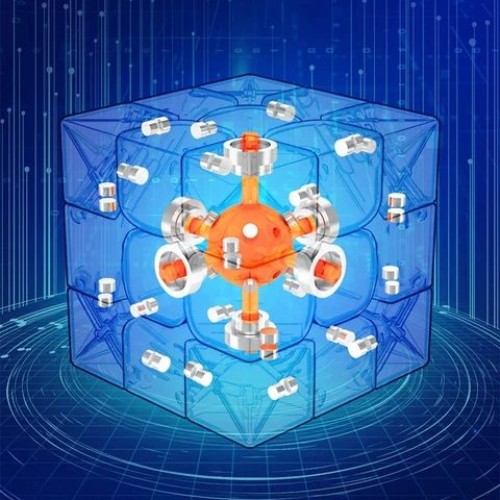
Magnet systems in cubes: what they are and how they affect solving
Magnets in speedcubes provide precise layer alignment and a stronger sense of
control. Depending on the design, a cube can feel more “stable,” “soft,” or
“snappy.” Below are the main magnet system types and what they do in practice.
In short
-
Piece magnets (edge↔corner) — magnets sit in edges and corners. When a layer
finishes a 90° turn, they pull into place and help the layer “lock in” accurately.
-
Core magnets (corner↔core) — extra magnets between corners and the cube’s core.
They pull harder toward the correct position and make the cube noticeably more stable at speed.
-
Adjustable magnets — magnet strength can be tuned. You can make the feel softer
(weaker magnets) or more defined (stronger magnets) to match your preference.
-
Track/Dual magnets (for 4×4 and bigger) — magnets help keep inner layers aligned.
This reduces “layer drift” and makes lockups less likely during fast turns.
1) Piece magnets (edge↔corner)
The most common magnet setup: magnets are placed in edges and
corners and attract each other as a layer turns.
How it feels
- Clear “clicks” and a firm stop at the end of the turn.
- Easier to stop exactly at 90°, fewer accidental over-turns.
- More predictable and comfortable for speed solving.
Who it’s for
- Almost everyone: from beginners to advanced solvers.
- This is the modern speedcube “default” standard.
2) Core magnets (corner↔core)
Here, magnets are added between corners and the core (corner↔core).
They work together with piece magnets and strengthen the centering effect.
What it does
- More stability: the cube “floats” less at high turning speed.
- Stronger auto-centering: layers snap into the ideal position more easily.
- A more “solid” feel: fewer random under-turns.
Who it’s for
- Solvers who turn fast and want maximum control.
- Anyone who feels standard piece magnets aren’t enough.
3) Adjustable magnets
These models let you change magnet strength — usually via a switch, slider,
or rotating mechanism built into the pieces (less commonly via swappable magnet capsules).
Why it’s useful
- Make the cube feel softer (weaker magnets) or more defined (stronger magnets).
- Match your style: smooth turning or maximum positioning feedback.
- Great if multiple people use the same cube (club/family).
Who it’s for
- Anyone who likes tuning a cube to personal preference.
- Anyone still figuring out their ideal magnetic feel.
4) Track / Dual magnets for 4×4 and up
On 4×4, 5×5, 6×6, and 7×7, inner layers matter just as much as outer ones.
That’s why some cubes add systems that help keep inner layers aligned.
This is often called track or dual magnets (names vary by brand/design).
What it does
- More stable inner layers: less drifting during fast moves.
- Fewer lockups: layers catch less often due to small misalignments.
- More even turning feel on big cubes.
Especially helpful for
- Speedsolving 4×4+ events.
- Anyone who wants the most stable big-cube experience.
How to choose magnet strength
- If you like smoothness and light turning — pick weaker magnets or adjustable magnets.
- If you want a crisp stop and confident control — pick stronger magnets, core magnets, or premium setups.
- For 4×4+ inner-layer stability is key — look for track/dual magnets if available.
No downloadable files available.
DEBUG LANG:
No videos available.
Speedcube Anatomy: Magnet Systems in Cubes — What They Are and How They Affect Solving
Tags:
Speedcube Anatomy,
magnet systems,
cube magnets,
piece magnets,
edge corner magnets,
core magnets,
adjustable magnets,
track magnets,
dual magnets,
4x4+,
stability,
control,
speedcubing guide